Project pathway
The quickest route to the right decision.
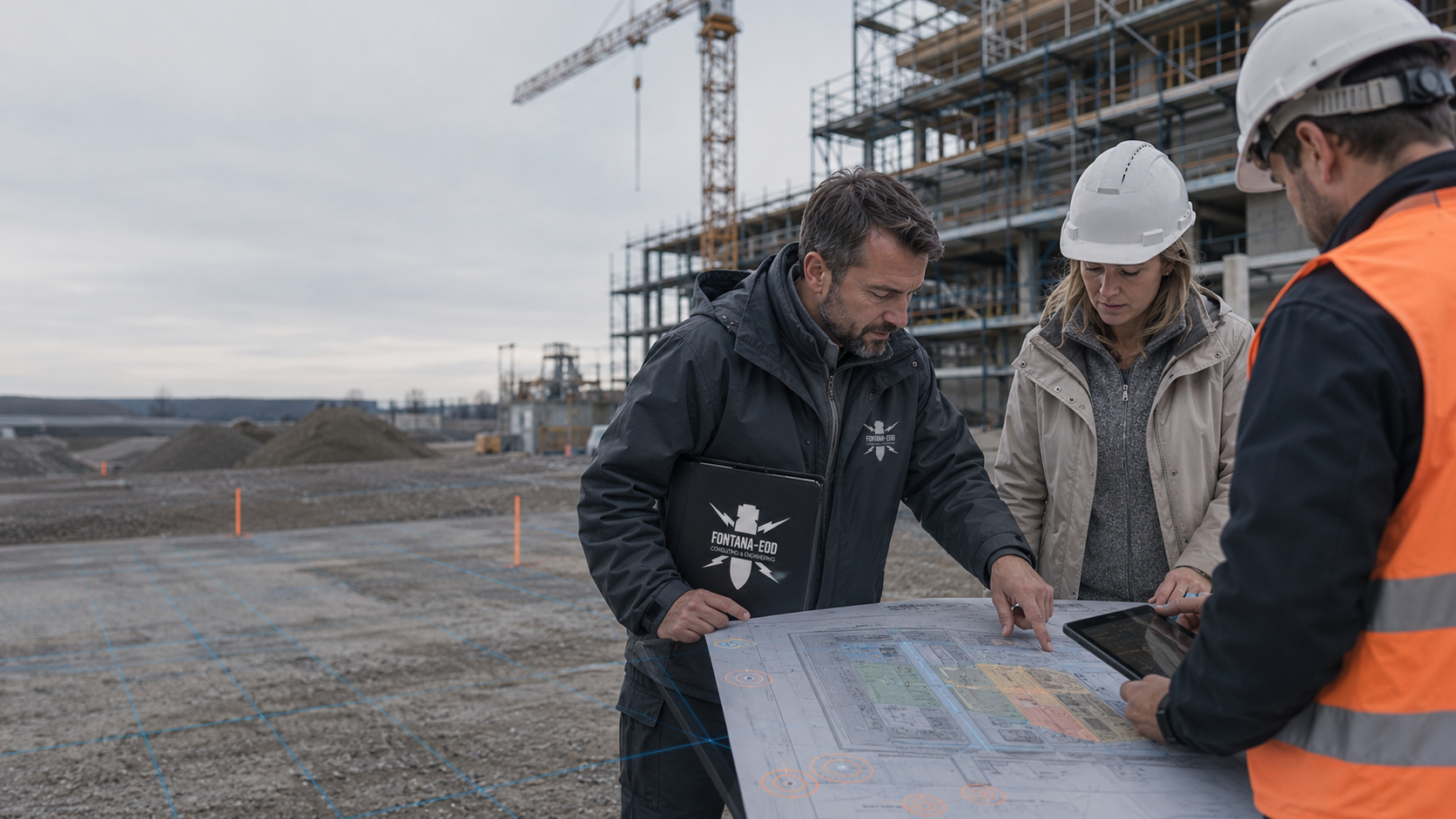
FONTANA-EOD compares existing explosive ordnance reports with your construction project and the financing partner's technical questions. The evaluation identifies the documented survey status, affected areas and surveys still needed. Send the specific question, current project plan and complete reports with appendices to coordinate the specialist contribution.
Identify the current plan and reports.
Describe the surveys needed.
Assign new reports to construction phases.
For the technical contribution, the financing partner's specific question is compared with existing explosive ordnance documents. Affected areas and planned ground interventions determine which evidence is needed. The response describes the documented status and outstanding survey questions.
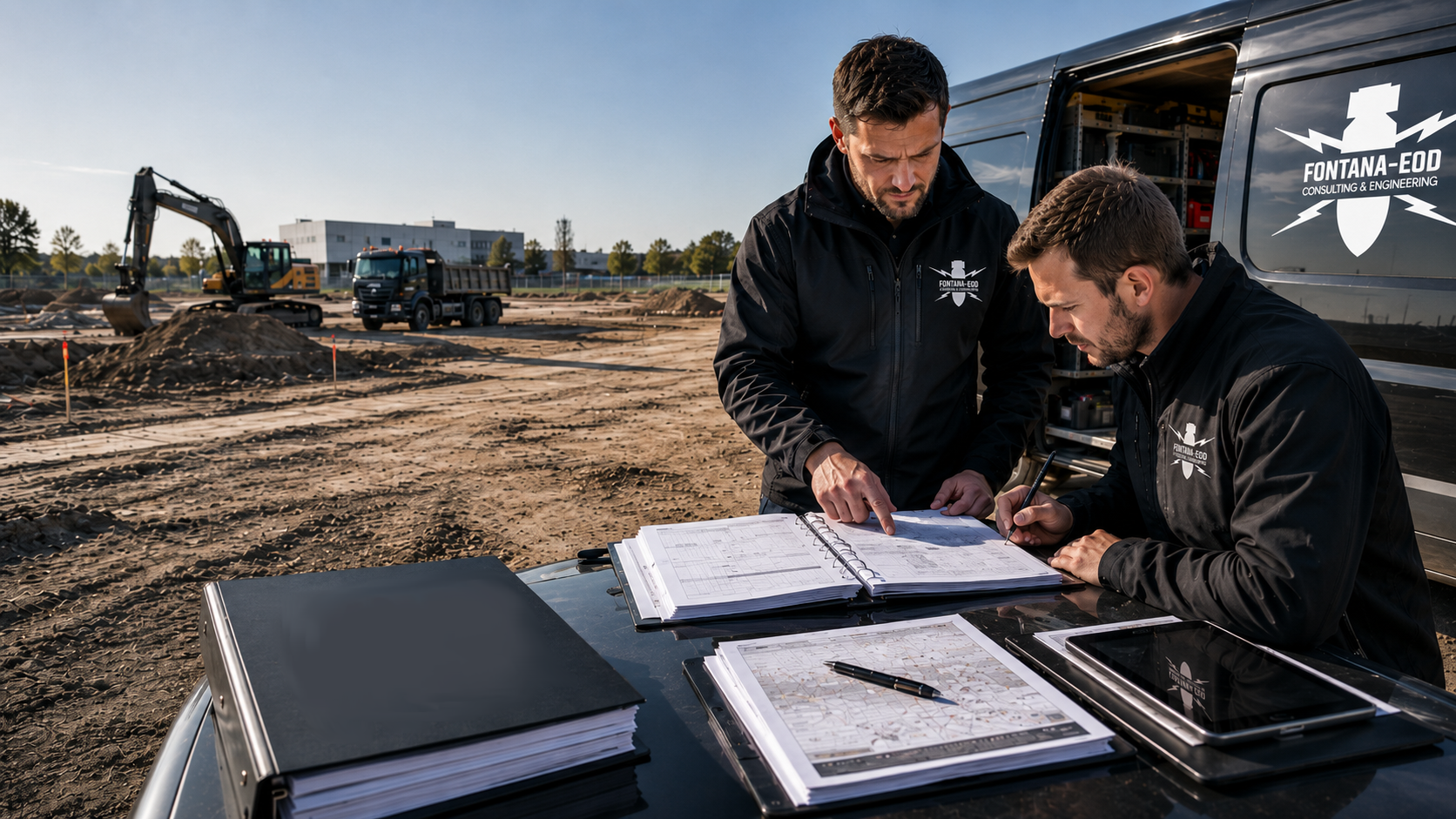
A question may concern existing reports, further surveys or a specific construction phase. The technical contribution relates to this subject. The location and affected areas are clearly identified. Unresolved options remain distinguishable from defined plans.
Assign technical questions to existing evidenceThe documents are considered together with their spatial appendices. They show which areas were surveyed and which conditions documented. The technical response remains bound to them. The summary identifies the documented subject and spatial limits of the reports.
Understand the spatial scope of the documentationCurrent areas, depths and execution versions are compared with the existing survey status. Deviations are identified specifically. The specialist contractor can assign further requirements. Earlier results are retained with their original spatial and technical references.
Compare groundworks with the survey status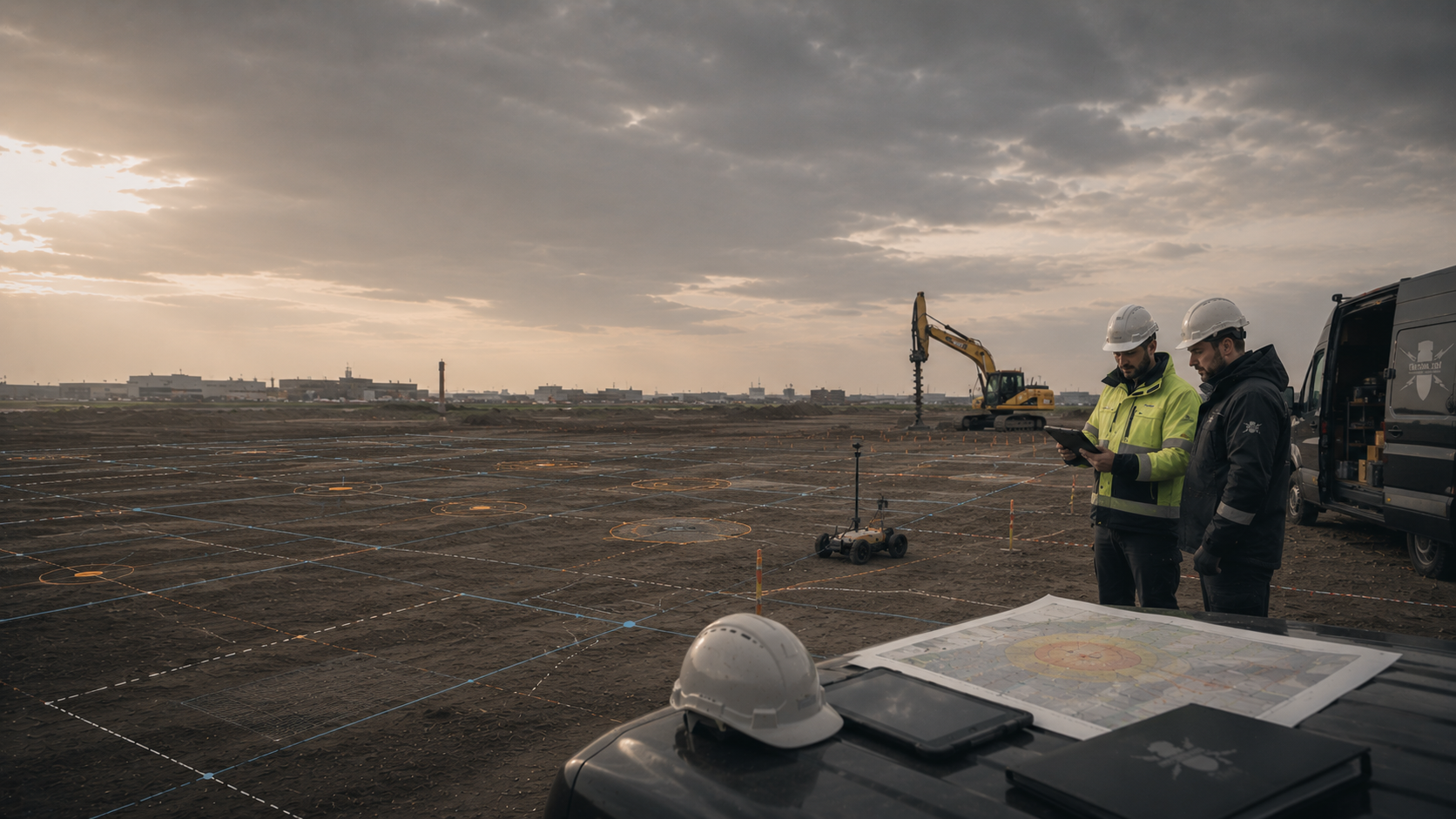
Surveys still missing are assessed according to the intended works and available findings. The project parties can incorporate this information into their respective tasks. The commercial assessment is carried out by those responsible for it. The technical contribution remains traceable as a separate component.
Select services for outstanding survey tasksEarly financing preparation requires different information from feedback on a construction phase already surveyed. State the reason for the enquiry so that existing results and services still planned can be assessed appropriately.
If the building location or foundation is not yet defined, the existing state of knowledge can first be described. The implications for future ground interventions depend on their later design. The discussion therefore distinguishes known property information from planning assumptions still open. The specialist opinion identifies the state of knowledge for the options considered. Once the building location and foundation are selected, this status is compared with the ground volume actually required.
Present the existing state of knowledge traceablyOnce the ground intervention is defined, its area, depth and execution are compared with existing reports. Ancillary areas and preparatory works are also needed insofar as they affect the ground. The technical response describes which tasks have been answered and which services remain outstanding. A report for the first phase is not transferred unchecked to later phases. Shared financing does not make their survey scopes identical.
Clarify survey requirements before the construction phaseIf a building moves or the foundation changes, the technical summary should identify the changed plan version. Existing results remain usable insofar as their documented scope still applies. The specialist review focuses on the actual change. This avoids both an unnecessary demand for a complete repetition and silently extending an older statement to new ground interventions. The difference from the previous status is briefly explained when the information is passed on.
Compare the changed plan and documentationIf the financing partner asks about surveyed areas, first clarify which construction phases the question concerns. The response identifies the corresponding reports and appendices and the survey scope described in them. A list of filenames alone does not answer the spatial question. Therefore include suitable plans or refer to clearly designated appendices. The recipient can then recognise which findings apply to which area.
If the question concerns works still needed, the outstanding technical question is described before naming a method or quantity. A missing historical assessment is a different task from surveying an already defined intervention volume. Explaining an existing report may also resolve an outstanding question. Further work should follow the specific information need rather than a general assumption about the whole site.
A reliable enquiry describes the scope and prerequisites of the service required. These include affected areas, planned depths and known access conditions. If quantities are not yet defined, they are recorded as open. An estimate based on provisional planning does not become a binding overall price merely by being included in financing documents. The technical definition of services and commercial assessment remain connected but identifiable as different tasks.
List the relevant reports and plans with their respective survey areas. Explain which results relate to the current plan and where this comparison remains outstanding. For “already surveyed”, state which area and depth were covered, when the survey took place and which limitations the report identifies.
Describe which explosive ordnance question still needs answering for which area. State known local conditions. Record whether documents are missing, a survey still needs planning or an already defined measure is to be carried out. An unresolved suspicion is not equivalent to a fully planned clearance assignment.
Access, site conditions and a sufficiently defined planning stage may be relevant to technical preparation. Show which are already available and what still needs clarification. Describe these prerequisites for the next work step. Merely assumed site access is insufficient to confirm execution.
Provide the plan version to which the enquiry relates. Where there are several options, identify which is actually to be assessed. A site plan without a date or identifiable assignment may cause avoidable questions. Add existing sections or depth information if they describe the intervention more precisely. The specialist response can then relate to an identified version that can later be compared with a change.
Survey areas, measurement conditions and limitations often only become apparent when the report and plan are read together. Therefore send the complete documents. A summary can help with orientation but does not replace a missing appendix. If only an excerpt of a report is available, this limitation is considered in the evaluation. A statement that depends on the missing part should only be passed to the financing partner after clarification.
A quotation describes an intended service; a survey report documents work carried out within its respective scope. Keep these document types separate. For an older quotation, also check whether its planning assumptions still apply. A service scope is not evidenced as fully executed merely because it was commissioned or paid for. Technical progress is assessed using results actually available and tasks still outstanding.
When a new report is available, a check is made which previously outstanding question it answers. A brief addition can identify the construction phase, result and remaining limitations. The complete report remains accessible. The same progress is not automatically assumed for other phases. If the report raises new questions, these are assessed by specialists. Communication to the financing partner can then explain the actual status without inferring completion of all explosive ordnance tasks merely from the arrival of a file.
Additional utilities or a changed retaining structure may affect further areas. First, the new ground intervention is compared with existing documents. Only then can the additional work required be described. A cost estimate for this addition remains identifiable as such and is not mixed with services already commissioned. The technical explanation identifies the reason for the change and its scope. The responsible parties decide whether and how the financing framework is adjusted.
Identify the plan version used as the basis and available findings. Refer in the overview to complete reports and identify outstanding tasks. Later additions can then be compared with the initial status without leaving it unclear which construction phases were considered at the time. If historical questions remain open, supplementary records of site use are researched and suitable wartime aerial photographs are assessed where available. The findings and limits of the assessment are assigned to the ground intervention now planned.
After a survey, explain which previous question it has answered. Record the documented spatial scope and remaining limitations. Receipt of a report alone does not establish whether all intended works are covered. Therefore compare the report with the areas and ground interventions currently planned.
If additional survey requirements exist, area, intervention depth, ground composition and metallic interference are checked. The measurement grid and borehole points where applicable follow the ground volume required. Access, existing utilities, authority conditions and surveys before preparatory ground interventions are coordinated before execution. On the basis of these conditions and the findings needed, the specialist planners select the suitable survey method and justify its suitability for the affected area.
The survey covers the agreed area under the documented conditions. Measurement data and findings receive location, elevation and depth references and are assigned to the plan considered. Restricted measurement conditions or inaccessible subareas remain identifiable for assessment.
The specialist contractor assesses measurement data and findings for the specific project. Outstanding areas and required follow-up measures are identified. Where explosive ordnance is recovered, the clearance record states its location, depth and the result. The report and plans supplement financing documents with their actual survey scope.
Different intervention depths, additional subareas or a changed construction sequence may require a new specialist review of previous results. Provide these changes for that review. The next summary should show which earlier results remain usable and which points need reassessment. Outdated statements must not be silently transferred to the new scope.
A clearance plan can record the methods and services needed for the project. For a cost enquiry, these services are described individually. The BFR KMR explain a structure based on project-specific component services. For coordination, preparatory works, the survey and documentation can, for example, be described separately. This does not establish a general price; the information must fit the specific assignment.
For a specific service item, the area to be surveyed and the result to be handed over are identified. An area includes its intended depth reference; for individual points or lines, the corresponding plan designations are used. The description also records the conditions assumed for the survey and who provides necessary access or other preparatory services. Where several specialist contractors are involved, services are assigned to their respective tasks. The report and spatial appendices are identified as components of the results handover. Project planning can then assign a service item to the intended construction phase. A summary for the financing partner refers to the complete service specification with its respective conditions.
For each cost estimate, identify whether quantities, access or further survey requirements remain open. An early quotation for a limited scope must not be adopted unchecked as a final total. Ask which services are included and which prerequisites the compilation relies on.
A provisional compilation states known quantities separately from assumptions still to be confirmed. If a working area changes, its new boundaries and depths are also provided for comparing the services. The responsible specialist contractor explains which existing items still apply and which additional task needs describing. For phased construction, it remains clear which phase each detail concerns. Site availability and necessary preparatory works also form part of the prerequisites on which the compilation relies. After an addition, the date, plan version and scope used as the basis remain available together with the quotation.
Evaluating explosive ordnance reports answers technical questions about the construction project. Identify the financing partner's specific requirements for specialist coordination. FONTANA-EOD undertakes the agreed explosive ordnance assessment and its documentation. The financing partner decides whether to accept the documents and grant credit. Clarify the financing structure, security and terms with the parties responsible for them.
The document review can assign existing findings to the current plan and identify information gaps. It does not generate new field measurement data. Its result is nevertheless useful for preparation if it makes clear which questions have already been answered and which addition is needed. The type of review assignment remains identifiable in the technical summary.
A survey covers the agreed area under the documented conditions. For onward communication, the method, spatial scope and result are read together. A method designation alone does not establish whether the planned ground intervention was fully covered. Limitations caused by site conditions or existing installations therefore belong to the findings and are not removed from a summary. Magnetometry records magnetic anomalies; TDEM records time-dependent electromagnetic responses from electrically conductive bodies. Under suitable ground conditions, ground-penetrating radar can provide additional information about structures and strata boundaries. Highly conductive soils may limit its range. Measurement coverage and interference are recorded for evaluation.
Further measures are assigned to the respective finding and area. A completion report may resolve a previously outstanding question. It is read together with the initial documents so that the work remains traceable. Findings for the area addressed are not automatically transferred to other areas or depths. For financing preparation, the documented status of the specific construction project matters. Where recovery has taken place, the clearance record documents location, depth and the result. It remains linked to the finding that prompted the work and the spatial appendices.
For deeper ground interventions, a check is made whether a supplementary deep-ground or downhole survey is suitable. Starting elevation, structural path and final depth are compared with the survey volume required. The measurement grid, borehole points and surveys before drilling follow the task and local conditions.
Where technically suitable conditions apply, preparatory excavation can be investigated through technical surveying and controlled layer-by-layer excavation. Each working level is technically surveyed and assessed before excavation; visual inspection supplements the method. Work sections, the stop signal, authority to issue instructions, reporting procedures and documentation are agreed before work begins. The survey is repeated down to the agreed excavation base.
FONTANA-EOD addresses the agreed explosive ordnance questions using existing findings and the plan described. The summary refers to the relevant reports rather than replacing their spatial and technical limits with a general overall assessment. Recipients can then ask targeted questions about an area, result or outstanding task.
For later updates, it should remain clear which information was retained unchanged and which was added. A new plan version may affect only part of the previous result. The comparison therefore relates to the actual change. Findings already usable are identified alongside tasks still requiring specialist clarification.
If technical documents feed into several reports or committee papers, their meaning should remain unchanged there too. A brief formulation must not extend the survey scope. Include the location in the original document and its relationship to the plan. Commercial conclusions may build on it but do not form part of the technical finding itself.
A question about an individual figure first requires clarification of what it represents: an area, provisional quantity, quoted price or service already delivered. These details are not interchangeable. The technical work explains their respective references and underlying prerequisites. This allows a figure to be used objectively in further project discussions without assigning it a broader meaning.
The question and affected area are defined before work begins.
The reports and planning versions used remain traceable.
The answer identifies its scope and the specialist questions still unresolved.
They identify the current plan version, affected construction phases and reason for the question. Changes are passed to the specialists involved. For the summary, a check is made which documents are available in full and which information still needs obtaining.
The appointed explosive ordnance specialist contractor assigns existing findings to the ground intervention and describes further survey requirements where applicable. The result identifies its spatial and technical scope. Required services are defined so that a related enquiry or further planning is possible.
In Germany, the explosive ordnance disposal services of the federal states and locally responsible authorities undertake hazard prevention and the handling of ordnance finds. Their involvement and the tasks of the public order authority and, where applicable, building control are clarified for the project location. Outside Germany, local responsibilities apply. Contacts, authority conditions and reporting procedures are assigned to the affected area and construction project.
They determine which information they need for their own decision and assess it within the respective contractual and project context. The financing partner decides whether to accept the documents, the mortgage lending value, terms and granting of credit. Specific technical questions can be referred back for further work.
Where document review leads to actual ordnance work in Germany, authorisation, competence and responsibility under the Explosives Act are related to the specific activity. The 1. SprengV includes requirements for specialist competence. The technical investigation commission is described separately and coordinated with the evidence required. § 7 SprengG concerns commercial authorisation for activities requiring it; § 20 SprengG concerns responsible persons’ certificates of competence. Under § 1b SprengG, searching for found munitions also constitutes handling.
When preparing actual work, DGUV Information 201-027 supports risk assessment and the selection of protective measures for ordnance clearance. DGUV Rule 113-003 addresses dismantling or destroying explosives or corresponding objects and disposing of found munitions, and is considered for applicable activities.
The BFR KMR provide technical foundations for investigation, planning and documentation. Their binding scope covers the federal properties specified there; application to other projects is agreed with the responsible parties. Site-specific authority requirements remain decisive.
If a possible ordnance item is found, stop work at the find location immediately. Do not touch, move or uncover it further. Leave the immediate area, keep your distance and keep others away without putting yourself at risk. In Germany, call the police immediately on 110; outside Germany, use the local emergency procedure. Further hazard response and involvement of the responsible ordnance disposal service follow local procedures and official instructions.
A result for a defined area answers the survey question asked there. Whether further construction phases, later uses or additional ground interventions are covered is checked against the documentation. The technical findings remain limited even when quoted in broader financing documents.
If execution scope, access or further findings are not yet established, these prerequisites are identified in the technical compilation. The responsible parties set cost and schedule contingencies on the basis of this information and their further project assessment.
The technical response relates to the intervention volume described. The plan, survey report and supplementary information must identify the same area traceably.
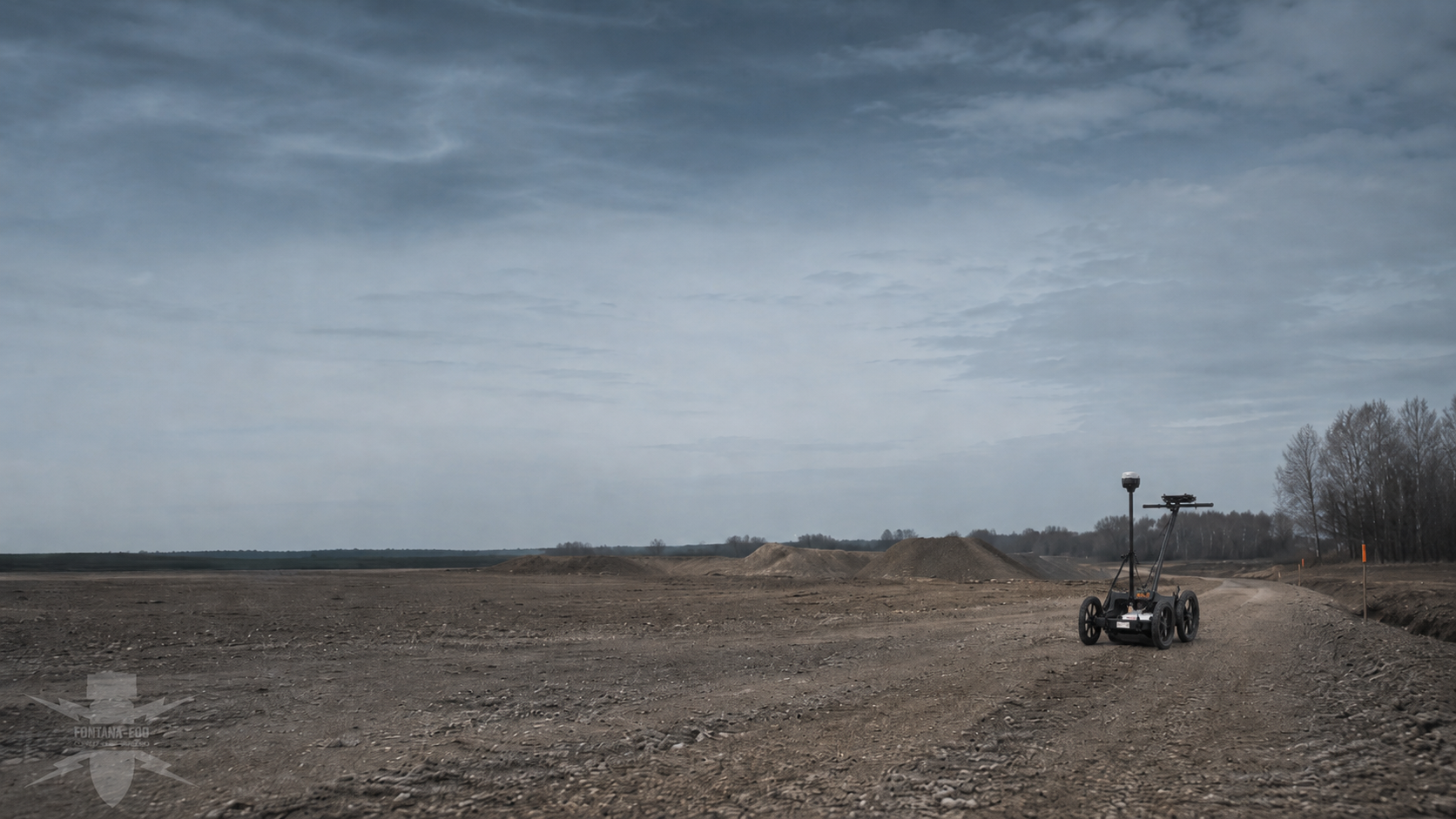
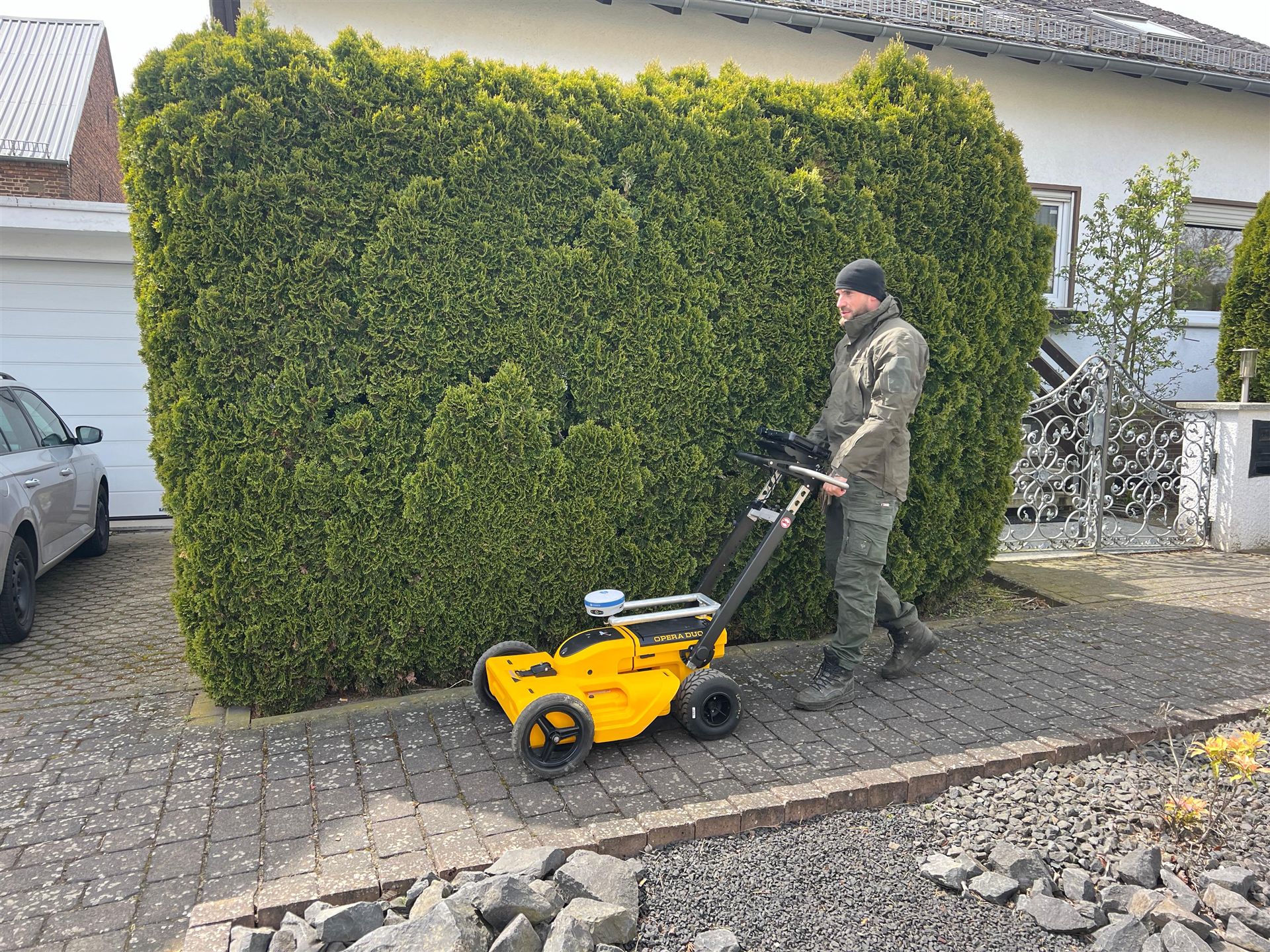
A survey cart on open ground with soil stockpiles in the background. Current construction phases and corresponding survey results are brought together for the question.
Submit the question with project documents
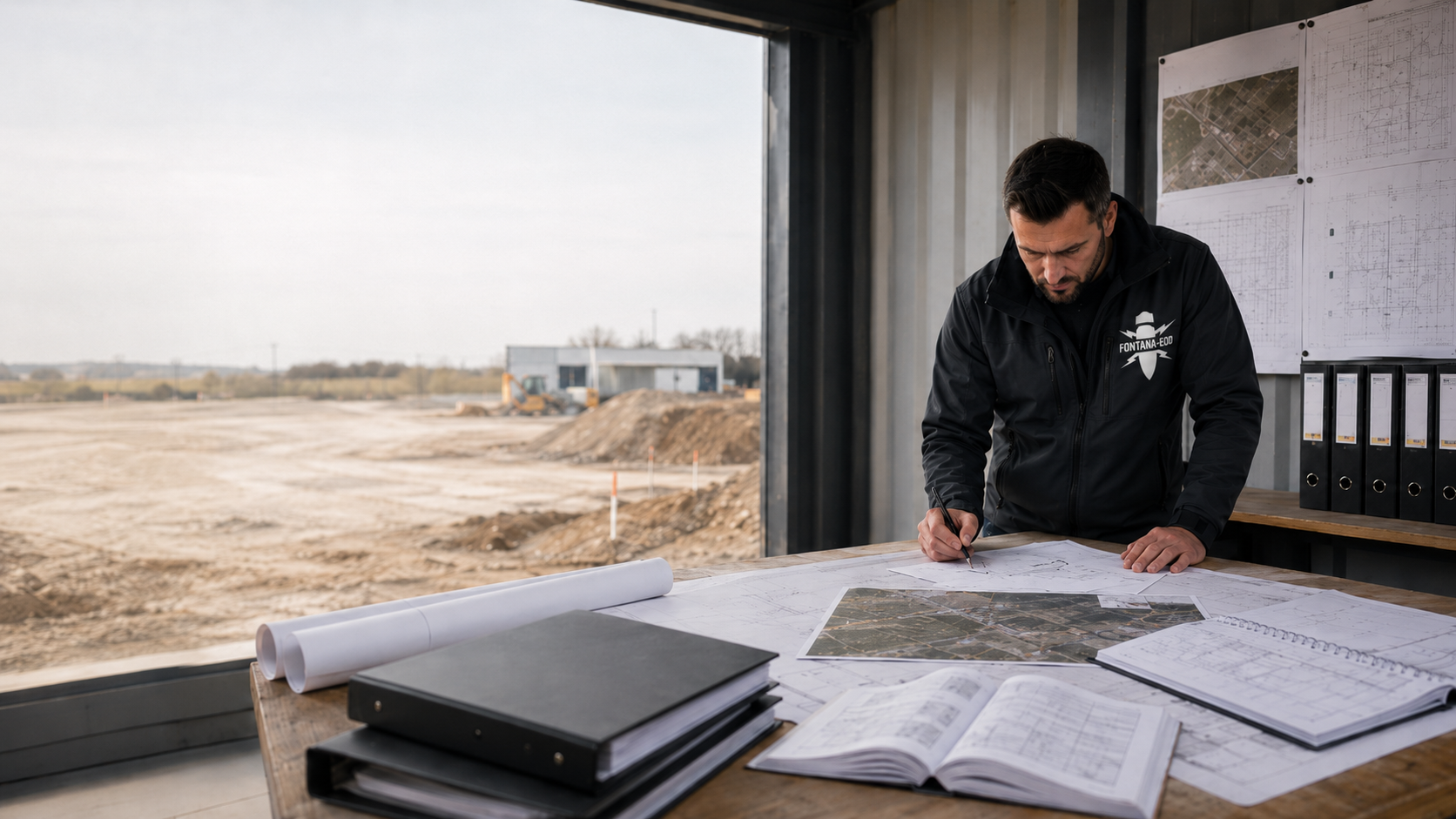
Identify the current plan, available survey results and works still needed in the summary. It can refer to existing quotations or service specifications provided their respective scopes and prerequisites remain identifiable. Complete reports and appendices continue to form the basis; an abbreviated overview does not extend their findings.
Completion of a survey evidences its documented area, depth and scope of services. Areas not yet worked on, coordination still outstanding and later planning changes are identified separately. The financing partner can use these documents to ask targeted questions. Those responsible for commercial matters assess the investment and costs; the start of construction is coordinated according to surveys still needed, authority conditions and other project prerequisites.
Technical sources: BFR KMR: clearance planning with a clearance concept – introduction · BFR KMR: geophysics · BFR KMR: documentation · BFR KMR: assessment and hazard evaluation · BFR KMR: cost assessment · BFR KMR: explanatory report
The BFR KMR are used as technical guidance; locally applicable requirements and responsibilities must be clarified separately.
Provide the financing partner's question together with the current plan and existing explosive ordnance reports. Identify the affected groundworks. FONTANA-EOD can align the technical task accordingly and identify additions needed for further work.
The response shows which evidence was used and which area it applies to. Outstanding technical questions remain visible. Recipients can use this status as a basis for their further assessment. Conditions and limits of the original surveys remain part of the handover.
If areas or intended ground interventions change, the technical question is compared with the previous status. Existing results are retained. Additions explicitly relate to the change. Earlier and current sources therefore remain distinguishable.
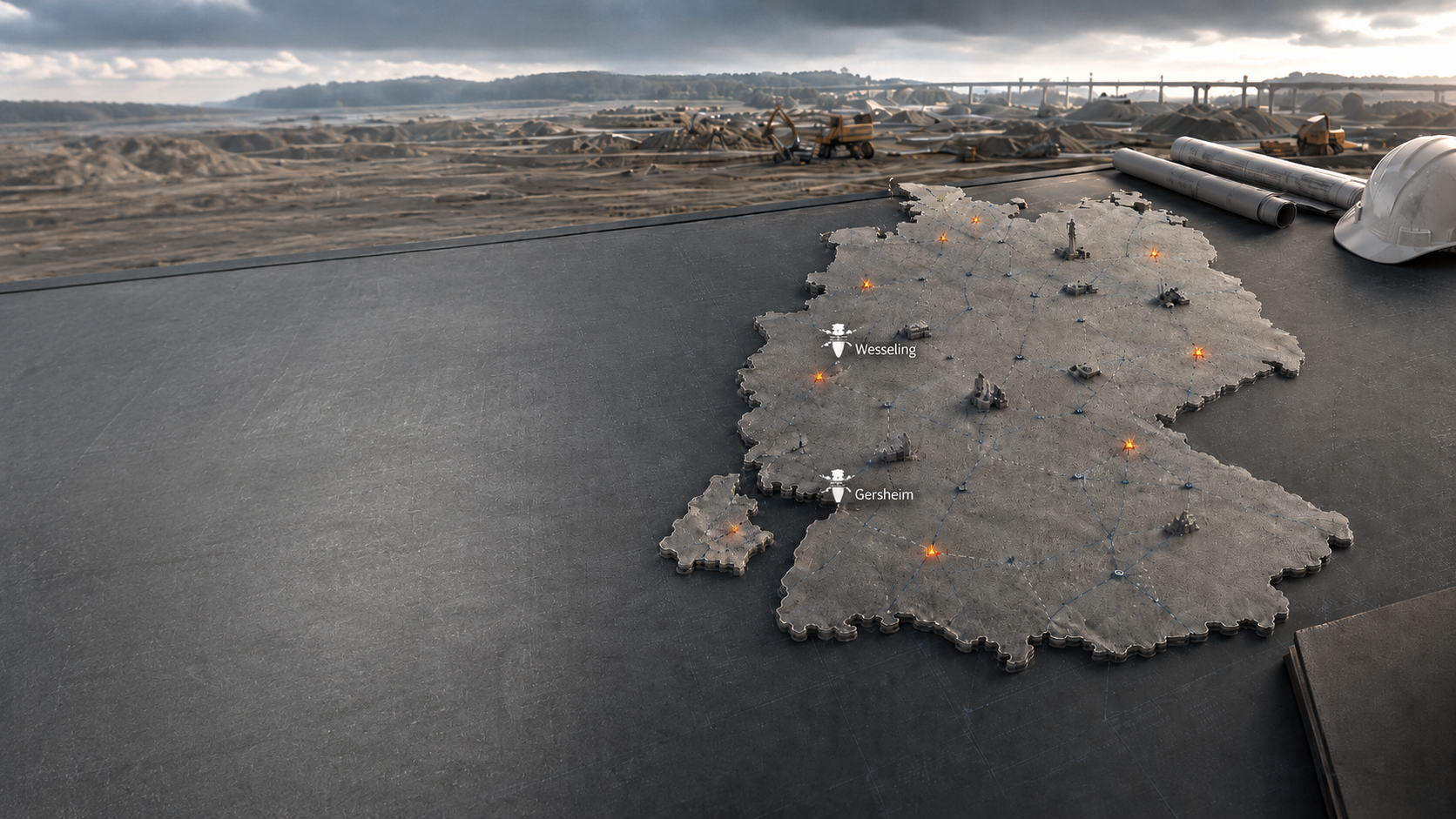
State the location and affected project area. Add the contacts for planning and available survey documents. The regional overview helps with orientation. The specific question and spatial reference remain decisive for the specialist contribution.
Reports, appendices and project-specific requirements are provided in an organised form. Information about earlier plans remains distinguishable from the current status. The responsible parties clarify outstanding baseline information. The technical response can then be traced to verifiable documents.
First submit the financing partner's specific question. Does it concern existing findings, further survey requirements or prerequisites for an intended construction phase? These questions require different evidence. A statement about the property address alone does not necessarily answer them. Also identify the affected areas and planned ground interventions.
The specific subject determines which evidence is needed for the technical contribution. A question about the previous survey status differs from preparing a new ground intervention. The project organisation makes this reference clear. Missing information is supplemented specifically.
Explore results and terminologyUnder the BFR KMR, suspected explosive ordnance is assessed case by case, taking account of existing or planned use. This does not establish a general figure for the probability of a construction project's failure. The specialist assessment explains existing findings and suitable further surveys. Commercial consequences are assessed by the parties responsible for them.
The technical assessment explains the documented state of knowledge and outstanding survey questions. Its spatial reference remains identifiable. Further conclusions are drawn by the parties responsible for them. A brief summary does not replace the corresponding reports and plan appendices.
Pass on case-specific results traceablyAn updated design may affect different ground volumes. The revised plan is compared with existing results. The specialist response is supplemented according to its subject. Earlier statements remain bound to the conditions considered at the time.
Explore results and terminologyTechnical information
Which documents help assess a construction project’s ordnance risks? The brochure explains investigation results, their limitations and the importance of traceable documentation.

FONTANA-EOD undertakes the agreed explosive ordnance assessment and documents the survey status, results and outstanding technical tasks. Credit assessment, financing terms and commercial decisions are handled by the parties responsible for them.
Such a general figure would not be a reliable statement for a specific project. The existing findings, intended ground intervention and specialist assessment of the individual case are decisive.
Only the scope actually described is apparent from it. Check the services and prerequisites included. Outstanding or excluded tasks must not be treated as already covered without specialist clarification. Area, intervention depth, ground composition, interference and access, together with evaluation and documentation, matter for costing. Cost estimates are assigned to the described component services and their quantity assumptions.
The summary should assign the new result to its survey area and the question answered. Remaining limitations and the relationship to the current plan must remain identifiable.
Compile the specific question, current project plan and existing explosive ordnance reports. Include existing service specifications or quotations with their prerequisites insofar as these form part of the question to be clarified.
A quotation describes the intended service and its prerequisites. The survey status reached is established by the documents for the work actually carried out. These two document types are kept separate in the project compilation.
The new intervention volume is compared with the documented survey scope. Usable results and outstanding questions are identified separately. Shared financing of several phases does not extend the earlier survey scope.
If an unexpected suspicious object is found, stop work in the affected area immediately. Do not touch, move or uncover it further. Leave the immediate area, keep your distance and keep others away without putting yourself at risk. In Germany, call the police immediately on 110; outside Germany, use the local emergency procedure. The competent authorities determine the next steps. Inform site management and the client; internal notification must not delay the emergency call.
Send the actual question from the financing discussion. Identify whether existing findings are to be explained, an outstanding task described or a planning change assessed. A precise question helps define the review assignment. State planned intervention depths, construction windows and known authority conditions.
Include the current plan showing affected construction phases and existing explosive ordnance reports in full. Relevant quotations may be included as additions. As intended services, they remain separate from documented survey results. Identify contacts and known access restrictions.
Review historical findings Check supplementary survey requirements Coordinate surveying alongside construction Clarify investigation of findings and recovery Assess project areas
State the requested response date and contacts who can be reached. Specialist coordination clarifies which findings are possible using the documents. Missing information or surveys still to be carried out are explicitly identified; a short decision deadline does not replace this basis.
Mark areas, depths or construction phases changed since the last enquiry. Also state whether new reports have been added. A change list can support the review but should refer to the complete current plan. Sending only a single new plan without context makes comparison harder. The technical response then explains which earlier statement continues to apply and which part was assessed anew.
If the enquiry relates to a quotation, send its complete version with the date and appendices. Compare the relevant items with the current plan. Clarify whether a quantity was derived from the plan or remains provisional. The specialist explanation can then address precisely this scope without including other trades or survey tasks not yet described.
Whether historical aerial photograph analysis, explosive ordnance surveying, surface surveying using GPR, magnetometry or TDEM, deep-ground surveys, downhole surveys, excavation supervision, area clearance or ordnance recovery is needed depends on the location, ground disturbance, depth, ground and existing documents. An early ordnance assessment provides clarity for tendering, programming, occupational safety and construction.
FONTANA-EOD combines its Section 7 SprengG licence, specialists holding Section 20 SprengG certificates of competence, suitable survey and clearance methods, and traceable documentation. Send the site plan, depth of ground disturbance, construction phase and existing documents for an initial technical assessment.


