Project pathway
The quickest route to the right decision.
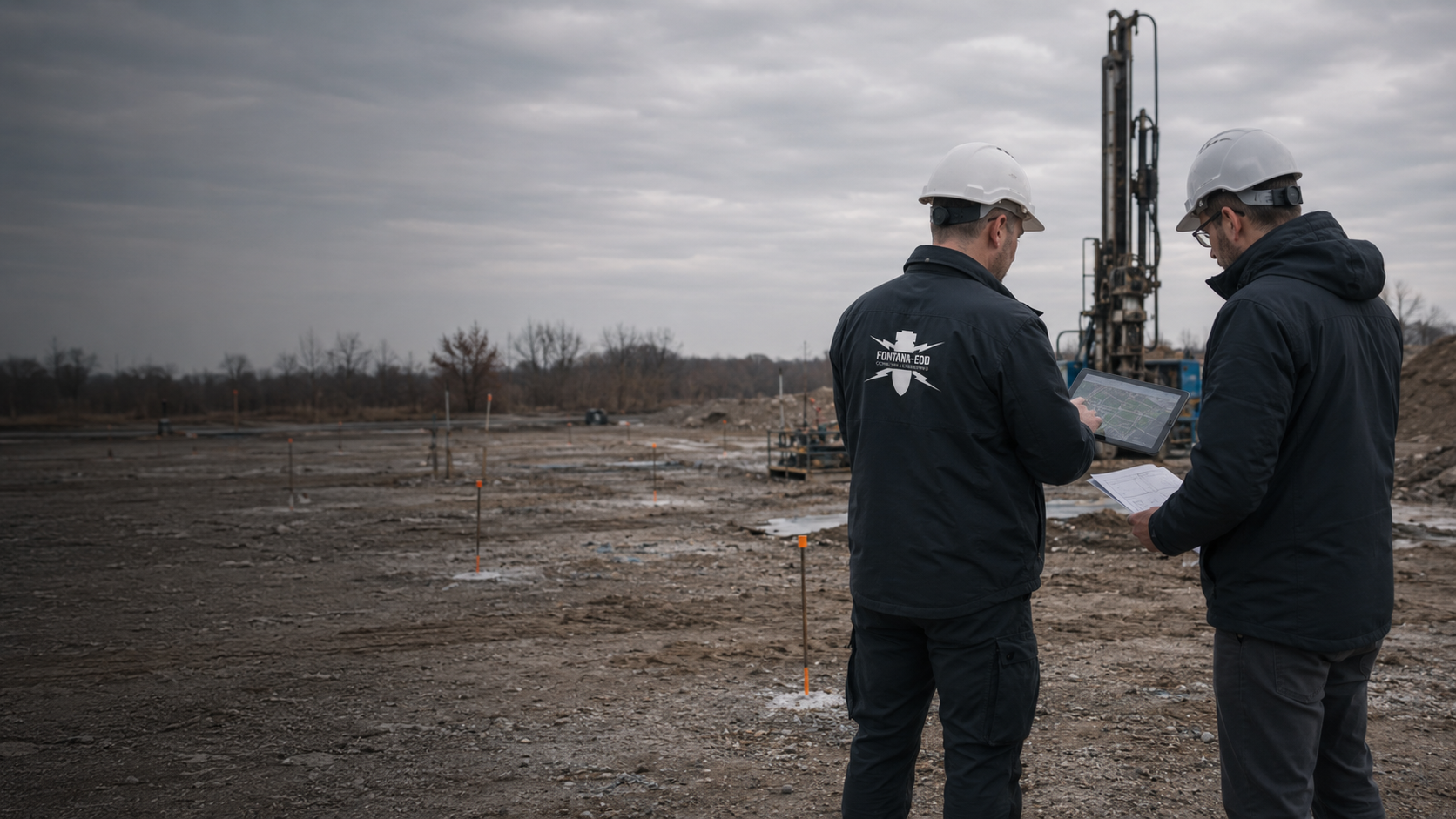
When soil is excavated, relocated or used as fill, it must remain clear which areas have already been investigated for explosive ordnance. FONTANA-EOD compares your excavation sections with existing reports, investigates the agreed area and documents the result. As client, site manager or earthworks contractor, provide the current earthworks plan with elevations, intended interventions and available reports so that investigation needs can be coordinated section by section. Assessment of pollutants and intended material use remains with the appointed specialists.
Mark the source area in the plan.
State the excavation boundary and planned depth.
Distinguish the explosive ordnance report from the material analysis.
An earthworks plan may contain cut areas, fills and intermediate conditions. For each intended intervention, state the area, depth and reference elevation. An area marking alone does not describe which ground volume is to be addressed. Also identify changes from the plan on which existing investigations are based.
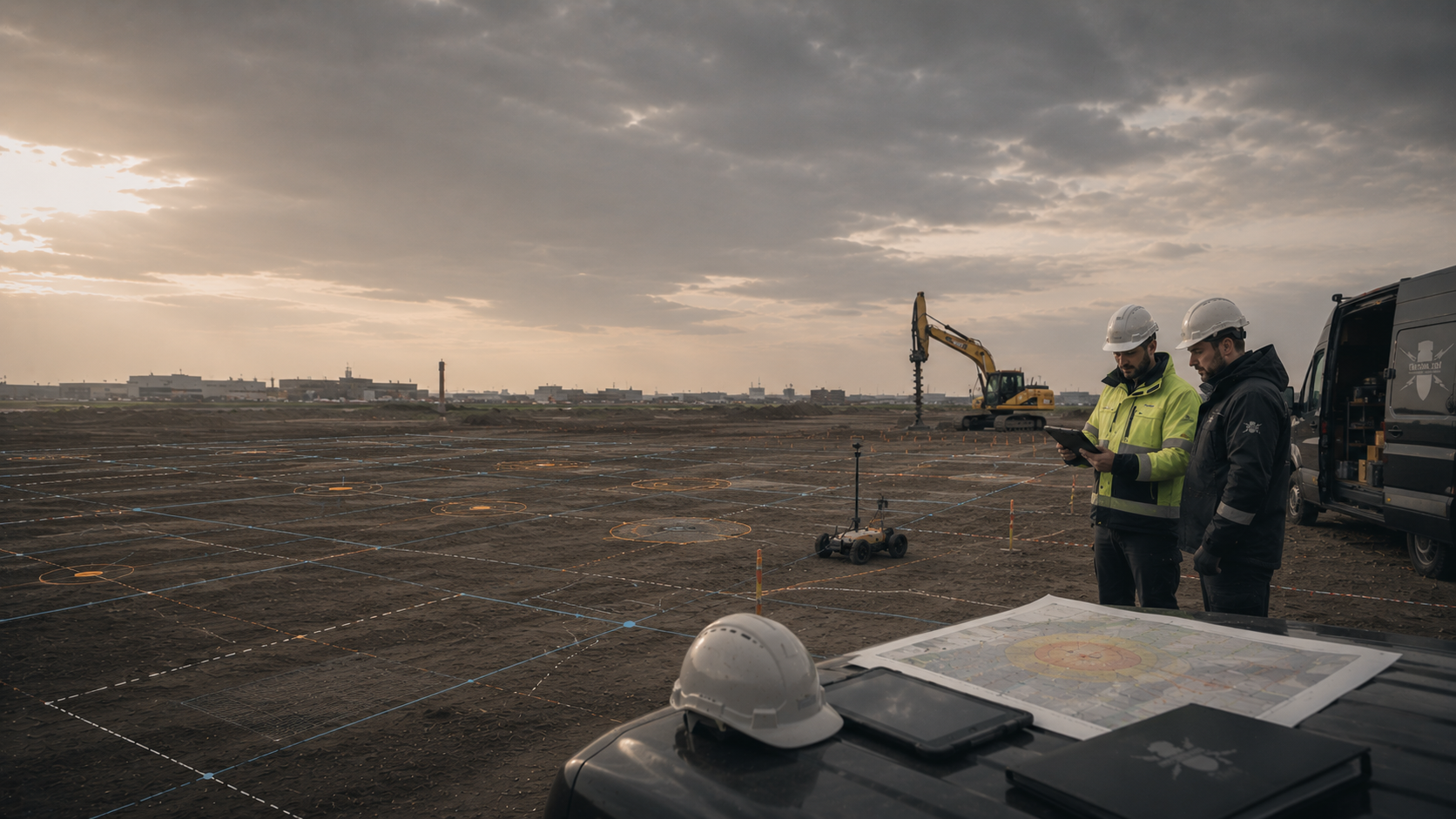
The earthworks plan shows the intended cut areas with depths and reference elevations. Explosive ordnance planning is related to these details and the existing findings. Unresolved alternatives remain identifiable. A shared construction area does not replace a description of each intervention.
Select services for the cut areas describedHard surfaces, installations and available working volumes are considered alongside the intended soil excavation. The specialist contractor assesses the appropriate investigation scope against these conditions. Inaccessible areas remain visible in the plan. Conditions changing later are coordinated as a new stage of work.
Coordinate methods with existing conditions and working volume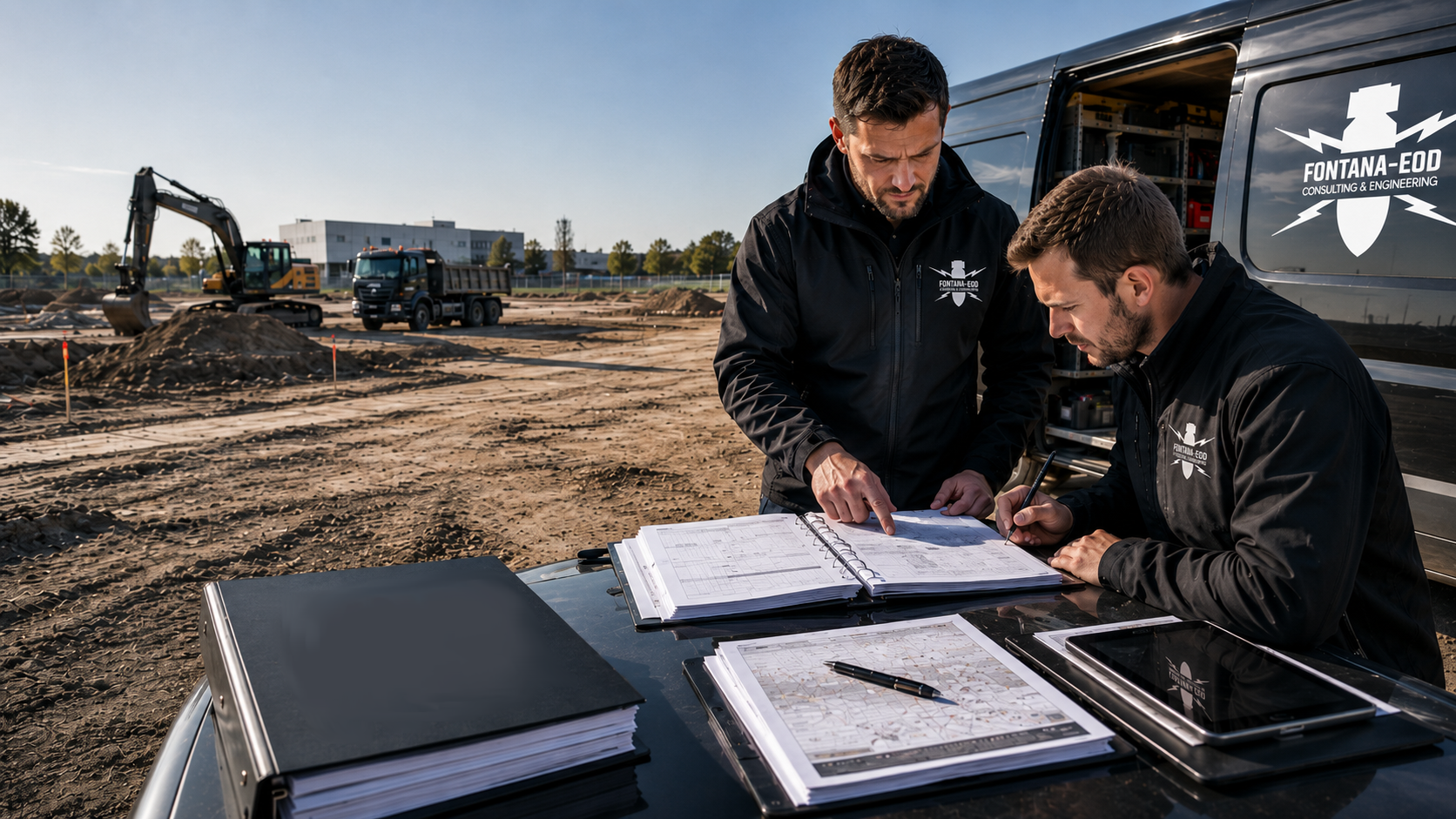
An earthworks project may comprise several sections separated in time. The investigated condition is therefore compared with the upcoming work at each stage. Changes reach those responsible before the next intervention. Areas already addressed and unresolved areas remain distinguishable.
Assign investigation stages to construction phasesFurther trenches, deeper excavation or changed construction boundaries are compared with previous results. The earlier documentation retains its original reference. Additional specialist needs are assigned to the new work. A general area name does not extend the existing conclusions.
Compare additional groundworks with existing reportsAn earthworks project may pass through several site conditions. For explosive ordnance work, the source area, intended intervention and existing results must remain clearly assigned between these conditions as well.
A planned excavation requires an area and lower boundary with a traceable elevation reference. The investigation is related to this volume and the existing findings. A report on a neighbouring section or an earlier utility is not sufficient merely because it is nearby. Before execution, the parts of the intended intervention covered and the question still needing clarification are checked.
Select investigation services for the planned excavationWhen relocating material, its origin should remain traceable. A new stockpile name does not change the scope of an existing explosive ordnance conclusion. Identify the section from which the material comes and the documents associated with it. Where materials are combined or provenance is unclear, specialists clarify the assignment. A report for one section is not transferred to the entire new stockpile without an evidenced connection.
Assign material provenance and investigation traceablyIf material is placed after an investigation, the original ground and later fill must be distinguished. For a subsequent intervention, the areas actually covered by existing results are checked. Elevations and available information about the material placed are needed for this. A new surface plan can support the comparison but does not replace assignment of the earlier investigation. Identical depth descriptions beneath different surfaces are not equated without checking.
Document changed ground and investigation conditionsCompare the intended volume with the complete report and its appendices. Where the conclusions fit, they can be used for the scope covered. An additional contract is derived from a question actually unresolved. Neither the size of the whole site nor a later file date alone determines the need. The intervention, investigation conditions and documented result remain decisive.
If a section is widened or deepened, the change must be identified in the plan. The technical review focuses on the additional volume. Existing results continue to be used where applicable. However, the previous report does not automatically extend to the new construction work. A precise description of the change helps prepare any necessary addition specifically and distinguish it from tasks already completed. Alongside the new excavation boundary, the change plan shows additional working volumes or temporary excavations wherever further ground interventions are intended. These areas are not silently assigned to the section previously investigated. Position, depth and the elevation reference used are submitted together for coordination. Site management can thus assign the technical response to the work section affected and coordinate the ensuing work with the current progress.
If plans, section names and material descriptions do not match, available provenance information is first compiled. A general assumption about the whole area would not provide a reliable assignment. Identify the data missing and who may be able to add them. Only after this comparison can the conclusions still usable and additional specialist work needed be assessed. Material provenance and area-based investigation results are kept separately traceable. A mass balance first describes the quantities of soil recorded; it does not provide an independent explosive ordnance conclusion for every part of the site. For relocated material, identify the source area, horizon concerned, date of relocation and current location where known. The responsible specialist planners assign this information to its respective purpose. Remaining gaps are identified before a conclusion for the new intervention is derived.
State where and to what intended depth soil is to be moved. Compare that volume with the documented investigation boundaries. A report for a neighbouring construction phase cannot be transferred merely because the land shares a boundary. Specialists clarify unclear margins before defining the next steps.
If ground has already been excavated or filled, the reference for depth details must be clear. The same numerical value beneath different surfaces does not describe the same volume of ground. Provide existing elevation information and the current work condition. This allows checking whether the report covers the next intervention.
Use the same source and section names in plans and documentation. The spatial origin of material and any associated explosive ordnance report must remain identifiable. Relocation does not enlarge the investigated scope. Identify unclear provenance rather than assigning a report without an evidenced link.
Define traceable names for excavation, stockpiling and subsequent placement. They should be identifiable in plans and documents. Where different names are already used, a clear mapping between them helps. Those involved can then discuss the same area. A new filing name must not suggest that a new investigation or broader conclusion also exists.
State the surface relevant to the report and the current ground condition. Survey records support comparison where available. A site plan shows horizontal extent but does not answer every depth question. Where there are several working levels, the level referred to must remain clear. Missing elevations are clarified by the responsible planning team rather than freely assumed for the investigation.
Explosive ordnance reports, material analyses and information on the intended use route are recorded according to their actual content. A shared project file is useful as long as the conclusions remain distinguishable. For each report, identify the source area or material investigated and the respective contract. Queries can then be directed to the responsible specialists. A contamination classification is not used to replace a missing explosive ordnance report.
Before adopting results, it is checked whether the information describes the same ground volume. An earlier investigation may remain relevant even if the surface has since changed. Its reference must be traceable. Provide available elevation records and the report's complete appendices. An identical depth number alone is not sufficient for comparison. The technical response identifies the part of the new intervention covered and where further clarification is needed.
The available documents are first considered separately by their original areas. A well-documented section does not automatically answer questions about the other. For further use, it must remain clear which conclusions can be assigned to which material or intervention. If this can no longer be fully established, the resulting limitation is described. Combining the stockpiles does not produce a broader explosive ordnance conclusion or replace a separate contamination assessment. Historical evidence, measurement data and assessments of findings remain linked to their source areas and reports. Where explosive ordnance is recovered, the clearance record documents its position, depth and recovery result; unresolved follow-up measures are assigned to the section concerned.
Use traceable names for the planned earthworks sections and link them to position and elevation details. Agree who reports changes to the responsible specialists. This allows assigning the existing report to the correct work section. Also record the planning version underlying the report. Provide these details with existing explosive ordnance reports to clarify the specialist contract.
A changed intended use route can raise additional contamination or waste-law questions. A new excavation boundary, by contrast, may extend beyond the ground volume investigated. Record what has actually changed and involve the respective responsible specialists. Clarify separately whether material assessment, explosive ordnance assessment or both tasks are affected.
Existing use information, historical documents and aerial photograph assessments are compared with the planned earthworks sections. They help assess suspected explosive ordnance and remaining investigation questions. Source areas and earlier work stages remain distinguishable. If historical questions remain open, additional records of past use are researched and suitable wartime aerial photographs assessed, where available. The findings and interpretation limits are assigned to the intervention planned today.
Ground stratigraphy, intervention depth, metallic interference and accessible areas determine method suitability. The measurement grid, borehole locations where applicable, and excavation sections are coordinated with the investigation volume needed. Access, nearby utilities and protection requirements are clarified before execution.
The commissioned investigation is carried out in the agreed earthworks section. Measurement data, findings and limitations are recorded with position, elevation and depth references. For work accompanying excavation, the agreed investigation and removal steps are documented section by section.
Measurement data and findings are evaluated by specialists. The report documents the ground volume investigated, site and work condition, methods used and remaining limitations. Further investigations or other specialist assessments still needed remain assigned to the section concerned and are coordinated with the next planned activity.
Provide the relevant explosive ordnance documents with the current plans. Explicitly identify unresolved areas or those investigated only to a limited extent. Compare older overviews with work that has since changed before passing them to executing contractors as a basis.
An analysis can provide information on the substances and material properties investigated. Its classification does not automatically answer whether a ground volume has been investigated for explosive ordnance. The material's contamination-related suitability for the intended placement or disposal route is assessed separately. For both reports, check what was investigated and which use or work it assesses.
Evidence remains related to the scope identified in it. If material from another area is to be added or a new section opened, its assignment must be clarified separately. Identify investigated and unresolved areas in a current overview. Further investigations or material assessments are assigned to their own section and contract.
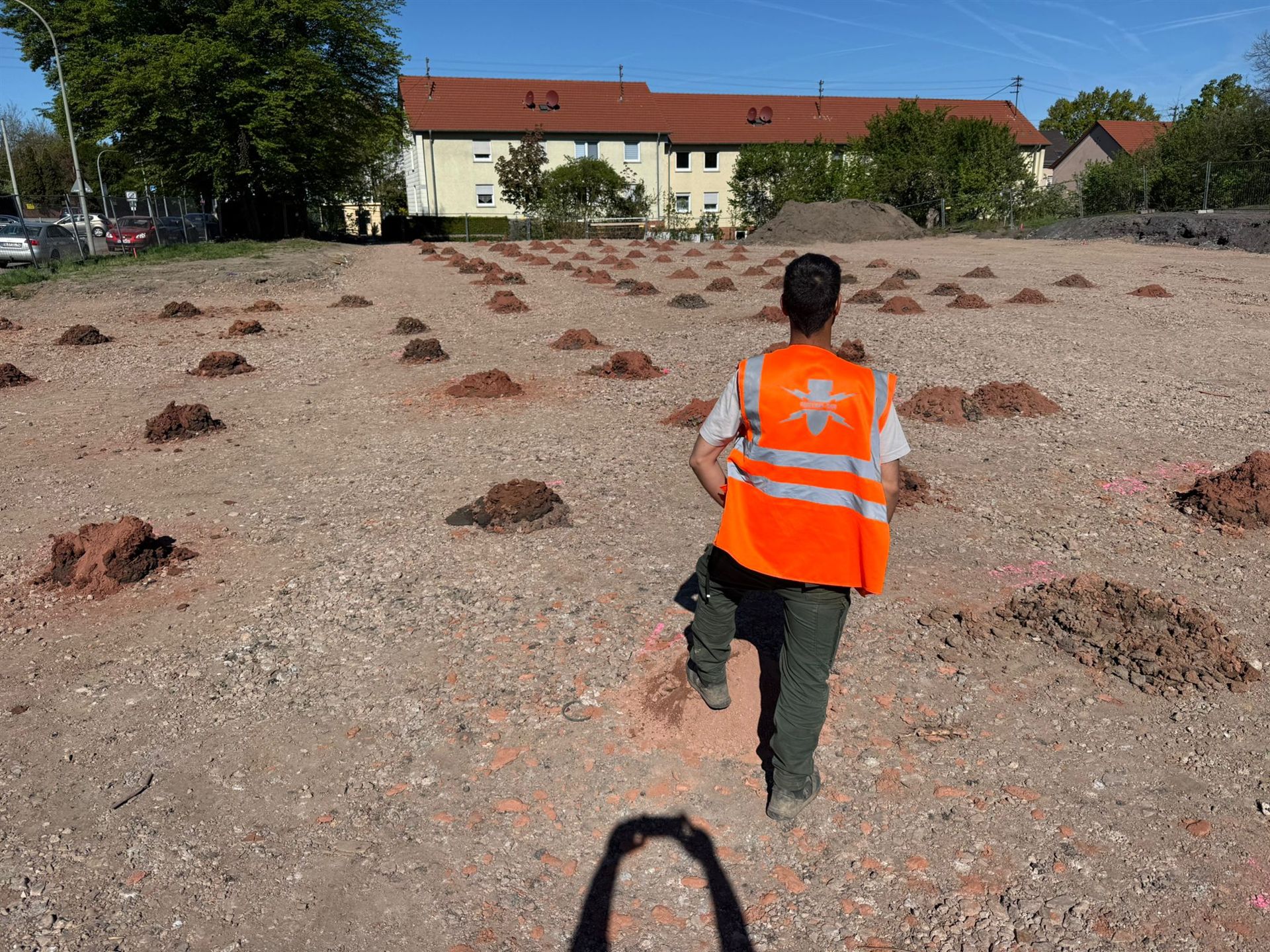
If an investigation is to accompany the works, its suitability for the planned intervention must be technically justified. The BFR KMR describe a construction-accompanying clearance method involving surveying. Merely visually observing excavation or material movements is not an equivalent investigation method. Occupational safety requirements and those of other disciplines must also be considered.
Document review shows what findings are already available and how they fit the current earthworks plan. It can identify missing appendices or unclear boundaries. The review does not replace new measurement data where needed, but can avoid an unnecessarily general investigation contract. The specific question still unanswered after evaluating the available information is decisive. Historical use information and aerial photograph assessments help assess suspected explosive ordnance and the need for further investigations.
Installations, metal and ground characteristics can influence the investigation. These conditions are considered together with the investigation objective. A method is not selected solely because it was used in another section. Conditions may differ even within one construction site. Known interference and limitations therefore belong in preparation and later documentation. Magnetometry detects magnetic anomalies; TDEM detects time-dependent electromagnetic responses from electrically conductive bodies. Under suitable ground conditions, ground-penetrating radar can provide additional information on structures and layer boundaries. Highly conductive soils can limit its usable penetration. Methods are combined according to their respective investigation objective and identifiable interference.
For deeper interventions or individual borehole and foundation points, the volume of ground to investigate is compared with achievable measurement coverage. Starting elevation, planned depth and spatial alignment are assigned to the investigation grid. Necessary investigations and protective measures are defined before drilling. Drilling depth, casing where applicable and documentation follow the task and local conditions.
If investigation is to be combined with earthworks, the sequence must allow the necessary technical investigations. Specialist planning describes which task is addressed in which condition. Merely watching material movements is not an equivalent replacement. Suitable and necessary preliminary investigation is not replaced indiscriminately by a contract to accompany the works. Results and unresolved areas must be handed over for further execution. Each working layer is technically surveyed and assessed before controlled removal in layers with supplementary visual inspection. The steps are repeated down to the agreed formation level. Excavation layers, stop signal, authority to give instructions and reporting routes are agreed with site management and specialist personnel before work starts. The excavation base and walls or slopes are systematically investigated using the intended method, and the results documented.
FONTANA-EOD addresses the agreed explosive ordnance task and documents the area covered. When passing information to earthworks contractors and planners, the report must remain linked to the current section and its elevation reference. A brief overview can help but does not replace the full appendices or the specialist limits of the result.
As earthworks progress, changes in geometry and site condition should be communicated to those responsible. A new excavation boundary may affect a different investigation volume, while a change in material route initially raises a different specialist question. Further work follows the actual change rather than a general reassessment of every existing result.
Planning versions and reports used remain traceable for later queries. When an overview is updated, it should identify the new information added. An existing result is neither silently extended nor invalidated merely by a new presentation. The specialist conclusion remains linked to the investigation performed and its documented conditions.
When the executing contractor changes, an organised handover of current documents helps. Identify investigated and unresolved areas and the next work planned. The new contractor should not have to infer from a general site marking which intervention is actually covered. Queries can be answered specifically using the associated reports.
The question and affected area are defined before work begins.
The reports and planning versions used remain traceable.
The answer identifies its scope and the specialist questions still unresolved.
They describe the intended cut and fill areas, working levels and sequence. Changes are communicated with current plans. Planning also identifies ancillary work affecting the ground and which documents are already available to prepare it.
The appointed explosive ordnance specialist contractor assigns existing results to the intervention and prepares the agreed investigation. The report describes the scope addressed and limitations. Findings for one section are not transferred to other source areas or new depths without a technical basis.
In Germany, state ordnance disposal services and locally competent authorities carry out hazard response and find management. Their involvement and public-order or building-control tasks are established for the project location. Outside Germany, local responsibilities apply. Contacts, requirements and reporting are assigned to the specific works.
They address the assigned questions about composition and intended use. Provenance and material routes must likewise be kept traceable. The assessment purposes remain separate even when reports are handed over together. Further work prerequisites are coordinated for the specific earthworks section with those responsible.
For explosive ordnance work in earthworks and soil management in Germany, authorisation, competence and responsibility under the Explosives Act are related to the specific activity. The 1. SprengV also regulates aspects including specialist knowledge. Before execution, those responsible clarify which corresponding evidence belongs to the contract. § 7 SprengG concerns the commercial authorisation for activities requiring permission, and § 20 SprengG the certificate of competence for responsible persons. Under § 1b SprengG, searching for found ammunition also counts as handling.
DGUV Information 201-027 supports risk assessment and the selection of protective measures for explosive ordnance clearance. DGUV Rule 113-003 concerns dismantling or destroying explosives or corresponding objects and disposing of found ammunition, and is considered for relevant activities.
The BFR KMR provide technical foundations for investigation, planning and documentation. Their binding scope covers the federal properties specified there; application to other projects is agreed with the responsible parties. Site-specific authority requirements remain decisive.
If a possible ordnance item is found, stop work at the find location immediately. Do not touch, move or uncover it further. Leave the immediate area, keep your distance and keep others away without putting yourself at risk. In Germany, call the police immediately on 110; outside Germany, use the local emergency procedure. Further hazard response and involvement of the responsible ordnance disposal service follow local procedures and official instructions.
Where planned handling in Germany requires authorisation under § 7 SprengG, the activity commissioned must be compared with the corresponding authorisation scope. Employers determine the protective measures needed from the specific working conditions. The earthworks sequence, working areas and possible interactions are therefore identified for coordination.
The requirements for a material route depend on the specific project. Technical explosive ordnance assessment, contamination classification and the permissibility of placement are assessed separately according to their respective subject. Changes to the intended use route are communicated to the specialists responsible. Associated documents remain linked to provenance and assessment purpose.
Even a preparatory working area or access route may require a ground intervention. Necessary investigations and protective measures are determined for that preparatory step before it starts. Therefore identify preparatory work when enquiring and agree its sequence with those technically responsible.
Markings and plans support assignment of a working area. The documented investigation boundaries and reference to the planned intervention remain decisive for the explosive ordnance conclusion.
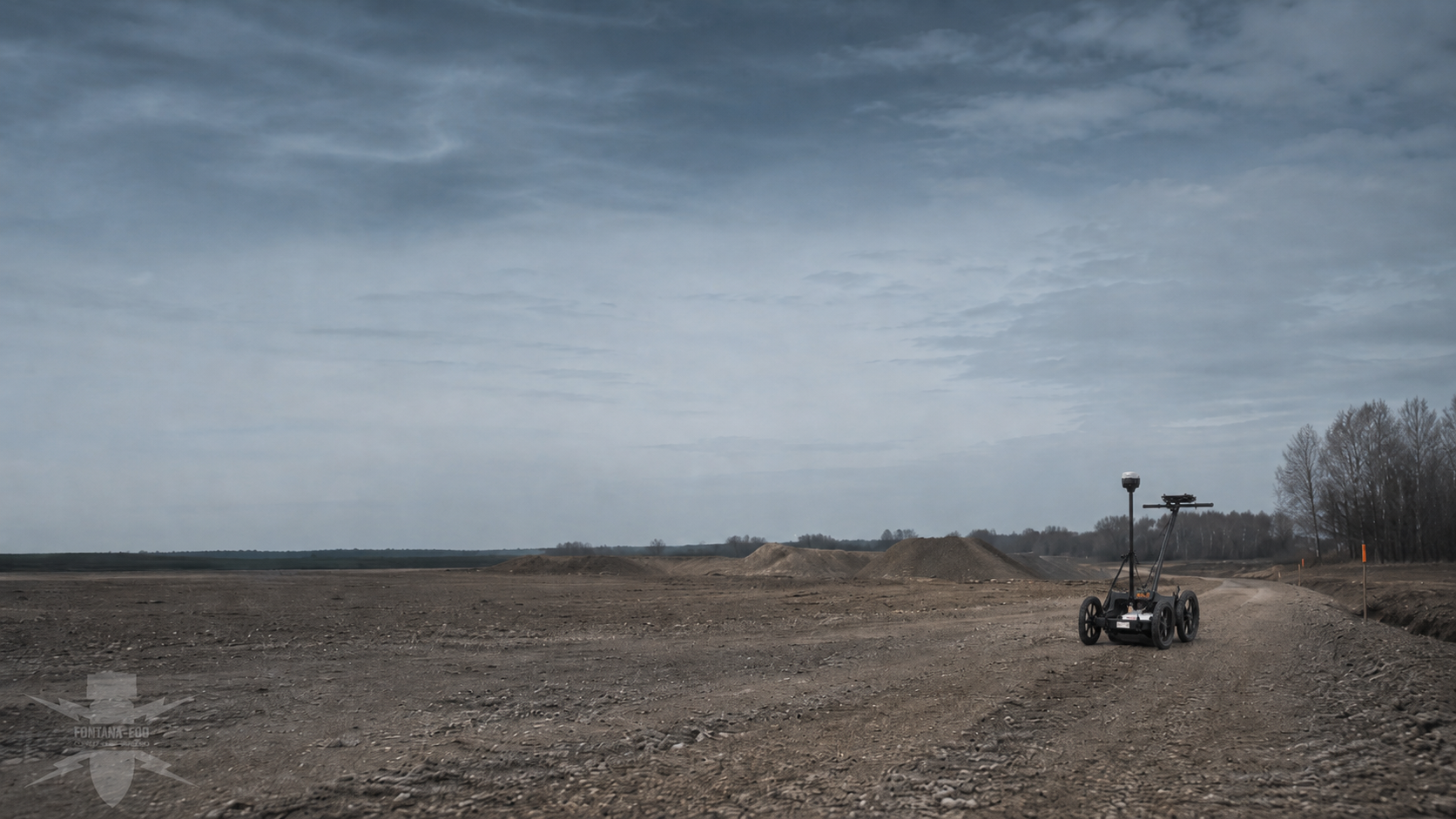
Survey cart on open ground. Excavation boundaries and reference elevations are needed for the enquiry.
Provide the earthworks plan for coordination
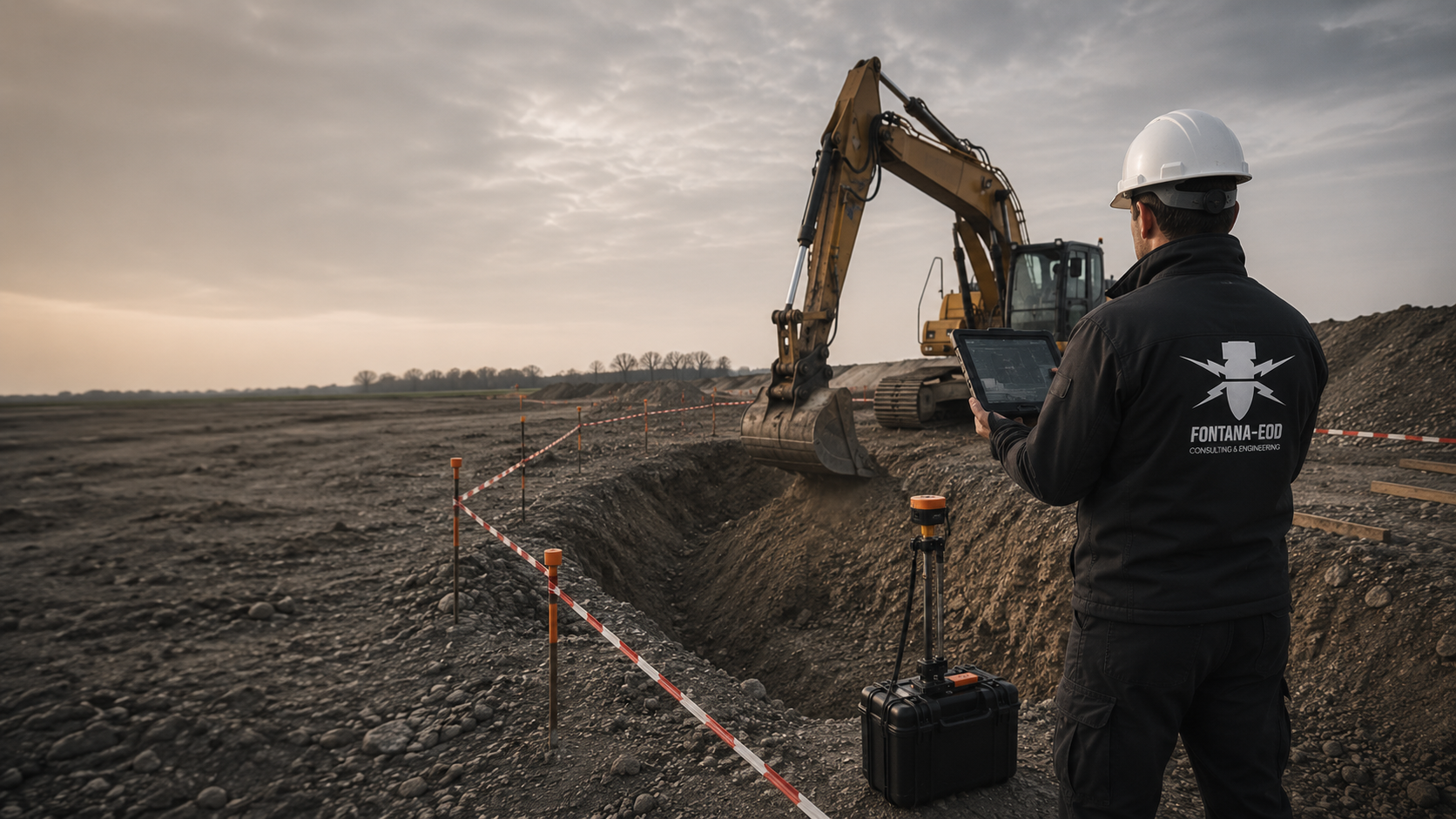
In the project overview, link the source area and work section to the associated explosive ordnance report. Contamination findings and documents about intended use are clearly assigned alongside them. This overview makes documents easier to locate; it does not replace the complete specialist reports or any other evidence required.
FONTANA-EOD documents the agreed explosive ordnance assessment, including the areas investigated and specialist limitations. The appointed environmental and soil specialists assess material composition and the intended placement or disposal route. In your enquiry, identify the planned earthworks and environmental or soil specialists already appointed.
Technical sources: BFR KMR: clearance planning with a clearance concept – introduction · BFR KMR: geophysics · BFR KMR: documentation · § 1 ErsatzbaustoffV: scope · § 6 BBodSchV: placing materials on and in soil · BFR KMR: construction-accompanying explosive ordnance clearance
The Baufachliche Richtlinien Kampfmittelräumung contain requirements for historical and technical investigation, clearance concepts, procurement and documentation within their defined federal remit. Their application to the specific earthworks project, and locally applicable requirements and responsibilities, are clarified separately.
The enquiry includes the current earthworks plan, reference elevations and available explosive ordnance documents. Add the planned construction sequence and known limitations. FONTANA-EOD can define the specialist task accordingly. Information on the material and intended use is supplied separately.
Those involved establish which section is to be addressed next. Investigation results are assigned to that section. Changes to the plan or site condition remain traceable. Documentation shows the progress actually achieved in the agreed specialist work.
The handover includes spatial assignment and the relevant investigation conditions. Other specialist documents remain available alongside them according to their subject. The conclusions needed for the following ground intervention are brought together. Unresolved areas remain explicitly identifiable.
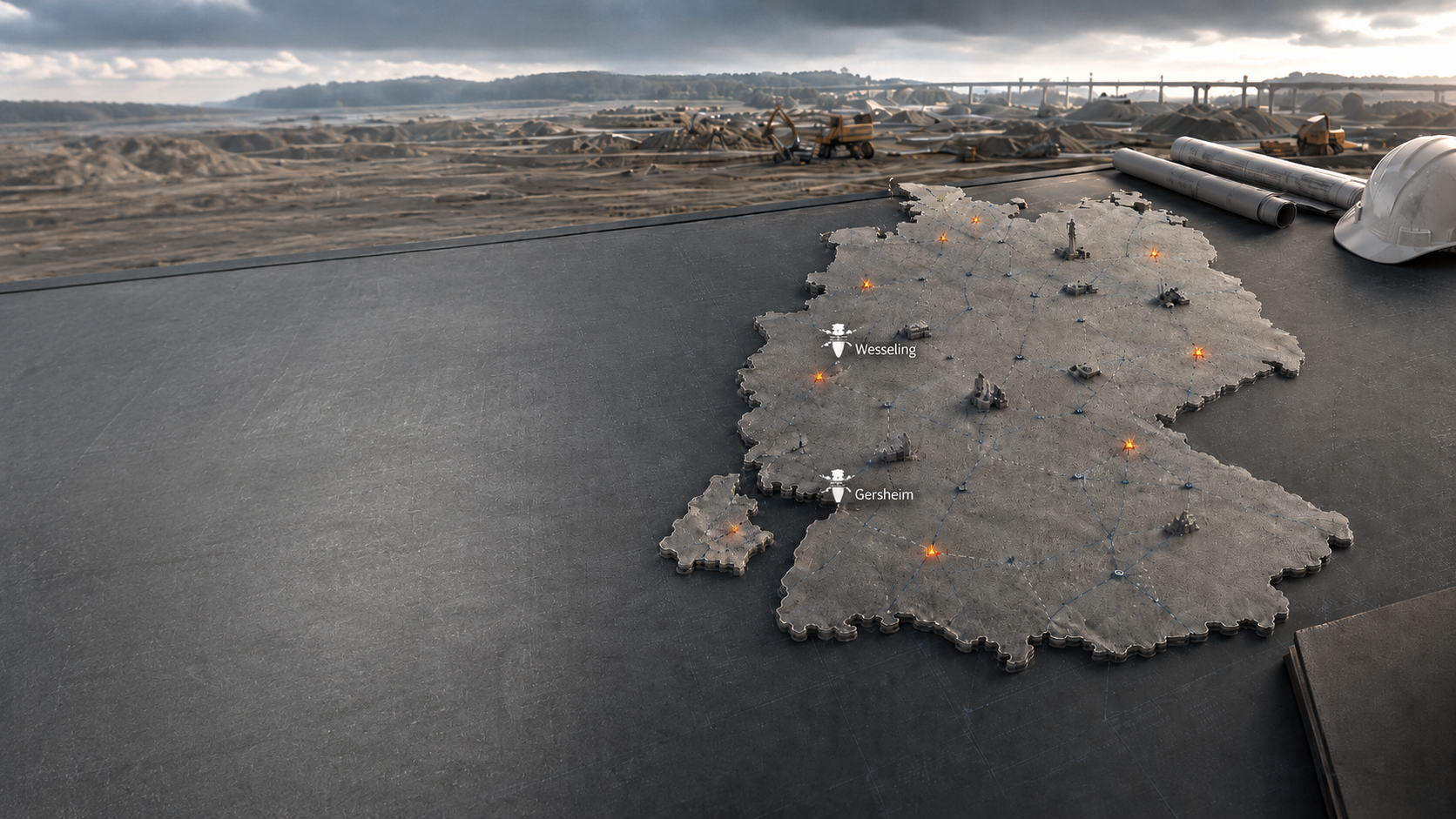
Identify the site and mark the planned groundworks in the current plan. Add the site management contact and available access. The regional overview provides orientation. Area, depth and reference elevation describe the specific task.
Existing reports and information are provided with their spatial appendices. Those responsible clarify unresolved requirements for the upcoming work. Conclusions concerning other sections remain distinguishable. This facilitates comparison with the current earthworks planning.
Soil management also includes questions about the material's composition and intended use. Germany's Substitute Building Materials Ordinance addresses mineral substitute building materials and their placement in technical structures within its scope. Separate soil-protection provisions also apply to placing materials on or in soil. § 1 paragraph 2 ErsatzbaustoffV identifies exceptions, including certain temporary storage and relocation operations. The specific material route is therefore assessed with the responsible specialists.
Project organisation brings together the specialist information needed and keeps its respective subjects clear. Information on material composition and use is provided by the responsible specialists. Explosive ordnance documentation remains related to the agreed investigation and its spatial scope.
Explore results and terminologyA depth figure is used with its starting elevation and the associated planning version. Changes to the surface or intended work can affect comparison. The references used therefore remain traceable in the documents. The next groundworks are assessed using these details.
Document elevation references and investigation depthsParts not addressed and unresolved questions remain identified in the plan. Site management considers them when preparing further work. When those areas become accessible or are specifically needed, the specialist requirement is coordinated. Existing results are reused with their actual scope.
Explore results and terminologyTechnical information
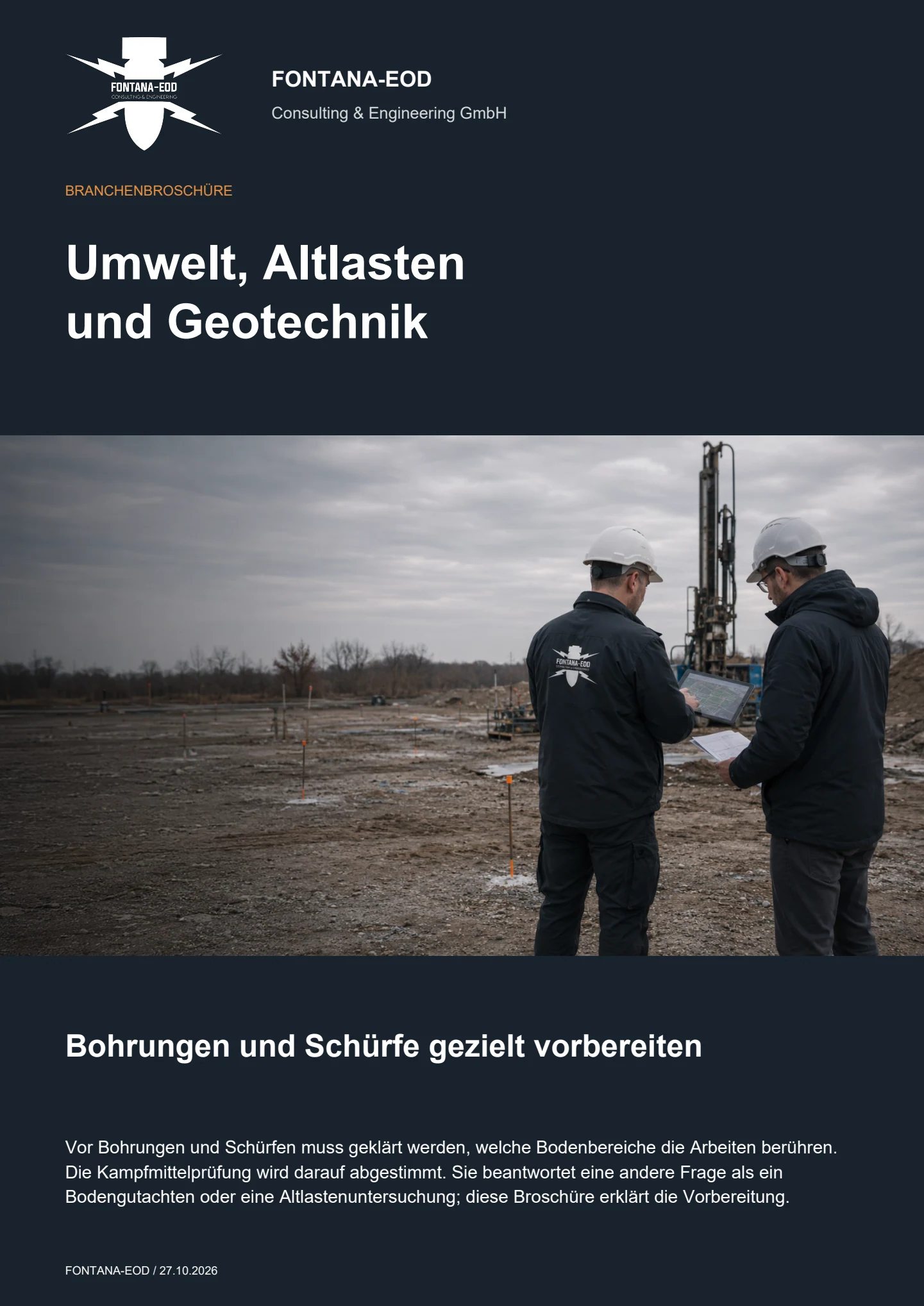
Ordnance checks, contaminated-land investigations and ground investigations serve different purposes. The brochure describes their interfaces and shows how drilling and other ground interventions are coordinated.
No. A material class does not confirm an explosive ordnance assessment. The respective investigations and their spatial or material-specific limits must remain separately identifiable.
It can be reused for the scope actually covered in it. New areas, different depths or changed elevation references must be compared with the documented conclusions.
No. Moving material alone does not extend the conclusions. Its origin, the area addressed and any new interventions must remain traceably assigned.
This must be clarified with the responsible specialists and, where applicable, authorities according to the specific intended use. The explosive ordnance assessment does not replace that assessment.
The planned work sections with position and elevation or depth reference, current ground condition and existing explosive ordnance documents are needed. Known planning changes and unresolved margins should be identified. The work required also depends on measurement conditions, suitable methods, necessary preparation, construction phasing and documentation scope.
After excavation or filling, the same depth below ground may refer to a different ground volume. Comparing with an existing report therefore requires both the original and current elevation references.
Their respective documents are first considered separately. Storing the material together does not extend the conclusions. Unclear assignments are clarified by specialists rather than replaced by indiscriminate transfer of a report.
If an unexpected suspicious object is found, stop work in the affected area immediately. Do not touch, move or uncover it further. Leave the immediate area, keep your distance and keep others away without putting yourself at risk. In Germany, call the police immediately on 110; outside Germany, use the local emergency procedure. The competent authorities determine the next steps. Inform site management and the client; internal notification must not delay the emergency call.
Provide the current earthworks plan with cut and fill areas. State the intended depth with its elevation reference and known deviations from earlier planning versions. Add the address or region and affected parcels where known.
Describe which source areas are affected and which relocations have already taken place or are planned. Unclear assignments are identified rather than combining reports solely on the basis of similar material descriptions.
Provide existing explosive ordnance reports in full. Material analyses can be provided alongside them with their respective reference. Identify those who can answer unresolved questions about planning, surveying or contamination assessment. Include available historical findings and aerial photograph assessments.
State which section should be addressed first and who needs the results for subsequent work. The investigation is coordinated with actual access arrangements. An appointment alone does not replace a sufficiently described working area. State planned construction time windows and known conditions for the section.
Agree to whom changed excavation boundaries or new working elevations are reported. The notification should identify the affected area in the current plan. A technical comparison can then focus on the specific change. Old and new documents remain distinguishable so that the basis used for each work step can be traced later.
A cost enquiry describes which investigation is needed for which section. State known areas, depths and access conditions and identify quantities still unresolved. Ask which preparatory work and documentation services are included in the quotation. An early estimate based on provisional planning is not adopted without checking as a definitive total. If the earthworks section later changes, the service scope is also checked. The adjustment should identify the additional or omitted part traceably. Agree which planning version, investigation volume and services underlie the quotation.
Whether historical aerial photograph analysis, explosive ordnance surveying, surface surveying using GPR, magnetometry or TDEM, deep-ground surveys, downhole surveys, excavation supervision, area clearance or ordnance recovery is needed depends on the location, ground disturbance, depth, ground and existing documents. An early ordnance assessment provides clarity for tendering, programming, occupational safety and construction.
FONTANA-EOD combines its Section 7 SprengG licence, specialists holding Section 20 SprengG certificates of competence, suitable survey and clearance methods, and traceable documentation. Send the site plan, depth of ground disturbance, construction phase and existing documents for an initial technical assessment.


